“Just like you” A concept that subtly appeals to the ego
Prepare for an uncomfortable reality: Humans are self-obsessed.
If you feel offended, don’t be! It’s not your fault. It’s hard-wired. Not a choice or a personality flaw. Ultimately, it’s what kept your ancestors alive.
While the risk of being chased by a sabre-toothed tiger is (thankfully) fairly slim these days, old habits die hard. Our subconscious is working round the clock, scanning for threats and opportunities that help us live to see another sunrise.
This innate programming, to notice the things that appeal to our self-interest, is not a challenge. It is a really powerful marketing tool.
When something looks and feels like it was made for us, our attention locks in. It is why the first question we always ask, when creating any form of marketing or communication, is: who is your audience?
Attention is only the beginning
Capturing attention – and let’s not downplay how difficult this is – is the first challenge. The next is what you do with it. And how long do we have to do this? In many cases, probably only a matter of seconds.
Time for another uncomfortable reality: you might think you’re in charge of making rational, considered decisions. You’re not. Your brain is making over 35,000 subconscious decisions for you, every single day. Imagine how exhausting life would be without this subconscious processing, especially if you already find it hard to decide what to have for dinner each night!
A useful shortcut from attention to engagement is emotion, because emotion is part of your fast brain and your ingrained need for self-preservation.
Getting “spidery” fear signals? Be wary, stay alert.
Did something make you smile? You’re safe, you can relax.
Feeling seen? Now you’re listening.
What does this look like in practice?
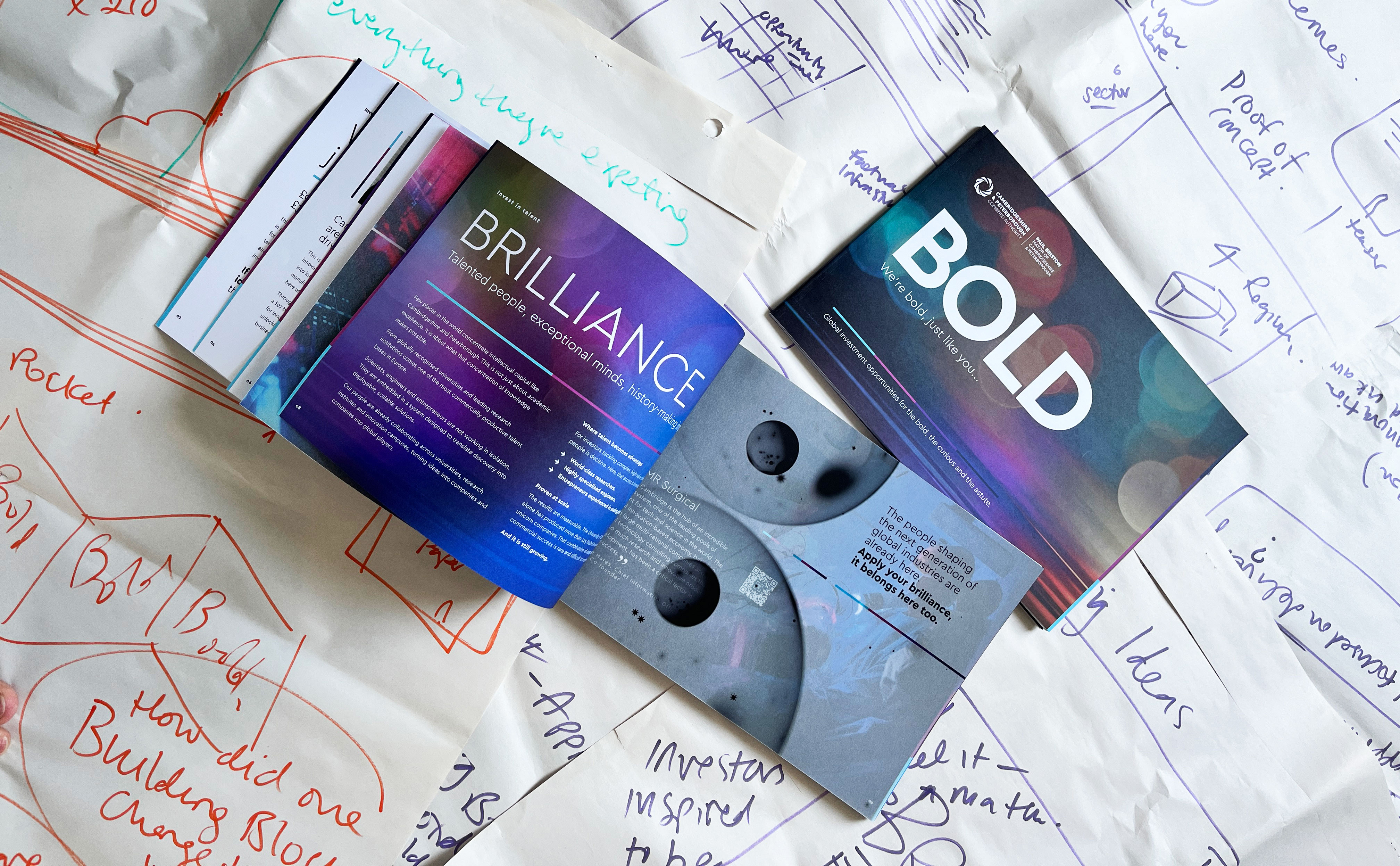
A brilliant example is our recent project with Cambridgeshire and Peterborough Combined Authority. We had a clear brief: create a prospectus for UKREiiF, the UK’s Real Estate Investment and Infrastructure Forum, where investors, developers, local authorities and senior decision-makers come together to explore opportunities, build partnerships and accelerate investment.
Understanding the audience was a big focus of the discovery workshop. We needed to get beyond “investors” as a broad label and think about what this audience is really looking for.
Investors and developers don’t just want information. They look for signals. Momentum. Confidence. Credibility. Opportunity. The sense that something is happening and, importantly, that they have spotted it at the right time.
They are bold. Curious. Astute.
Just like the region.
We had a match!
Just like you
“Just like you” became the strategic and creative thread for the prospectus.
The opening proposition, “Global investment opportunities for the bold, the curious and the astute”, immediately reframed the document around the audience, not just the place. It then mirrored those qualities back to the reader: “We’re bold, just like you”, “We’re curious, just like you” and “We’re astute, just like you.”
This was not flattery for the sake of flattery. It was relevance.
“Just like you” worked because it positioned Cambridgeshire and Peterborough as a place with the same qualities the audience values in themselves: ambition, intelligence, pace, judgement and appetite for growth.
We weren’t just asking investors to look at the opportunity. We were inviting them to recognise themselves in it.
More than words
The bold approach did not end with the copy.
We wanted the design treatment to embody the same confidence. The result: striking typography, image-led storytelling, bold section openers, interleaved with tactile, transparent pages, and a more editorial rhythm. The prospectus demonstrated greater pace and more presence than any of the other regional prospectuses we’d looked at during our competitor analysis.
Ultimately, it made investors feel that Cambridgeshire and Peterborough was the kind of place they would naturally be drawn to. A place of momentum, intelligence and ambition. A place for people just like them.
The takeaway
That is the power of audience-first communication.
When people see themselves in your message, they are more likely to give it their attention. When they see their ambitions reflected back with credibility and confidence, they are more likely to believe the opportunity is worth pursuing.
Appealing to the ego might sound uncomfortable. But done well, it offers the most direct route to recognition and engagement.
Learn more about how we delivered this project