
Renovation Underwriting
Turning specialist insight into broker engagement
Turning specialist insight into broker engagement

HSBC UK’s Women’s Business Growth Initiative two-year anniversary event takes place in London on 23 September, and we’ll be there.
This national event will bring together women business owners to celebrate two years of the initiative, make new connections and explore resilience, growth and the power of strong networks.
Keystone is one of six businesses selected from the Women’s Business Growth Initiative community to host a dedicated stand on the day. And rather than use that space simply to talk about ourselves, we want to use the opportunity to share something useful with the 120 guests.
Our Build Your Marketing Momentum stand will invite business owners to take a closer look at their own marketing through an interactive self-assessment, designed to help identify what’s working, what might be getting in the way and where to focus next.
And for anyone who wants to take that thinking a step further, we’ll also be opening up our Three for Free consultancy sessions, giving organisations an opportunity to bring a current marketing challenge or opportunity to the table and get some independent strategic thinking in return.
Keystone’s Managing Director, Hayley Williams said:
“Being selected to showcase Keystone at the anniversary event is a real privilege. But what I’m most looking forward to is bringing some of our thinking into the room and sharing it with other business owners.
“Whenever someone spends time with us, we strive to leave them with something useful, whether that’s a fresh perspective, a question that makes them think differently or a clearer idea of where to focus next.
“It feels very much in the spirit of an event that’s about celebrating business growth, sharing experiences and recognising the power of a strong network that we take this ethos to this special event too.”
You don’t need to be at the event to build your own marketing momentum. Our Marketing Momentum self-assessment and Three for Free sessions are available more widely too.
If you’d like a copy of the assessment, click the button below to download.
Or, if there’s a marketing challenge or opportunity you’d value an experienced outside perspective on, book a Three for Free session. You’ll get a focused 45-minute consultancy conversation with Hayley, followed by three tailored recommendations you can take away and act on, with no obligation.


Six rules for using AI at work responsibly.
There is no shortage of opinions about AI. It’s going to transform everything. It’s going to take everyone’s jobs. It will make us more productive, but it will also stop us thinking and make us lazy. It’s an extraordinary creative tool, and also the death of creativity.
The pros and cons of AI have been discussed earnestly and endlessly. Rather than add to that noise, we decided to do something different, knowing that even within our small team, there are differences in the way we feel about AI and how we use it. So, we sat down together, recorded the conversation and talked freely to see whether we could come up with ‘our rules for working with AI’. From our different perspectives, as creatives, writers and marketers. What we like about it, what makes us uncomfortable and where we think the human bit still matters.
We were hoping for a bit of disagreement. Chantal, Head of Brand and Creative Strategy, was, in her own words, quite keen on “fisticuffs”. No chairs were thrown.
We did not all adopt AI with the same energy. Chris, Campaign and Client Manager, described himself as “a dinosaur” when it comes to new technology and admitted that, when ChatGPT was first shown to him in a pub, he largely dismissed it. “I thought the human brain was far more capable and far stronger than anything machines could produce.”
That changed once he started using it properly.
Not because AI suddenly became cleverer than him (he questions that), but because he found a different role for it. “It feels like a critical friend.” For Chris, AI is a sounding board. Put in an idea, some half-formed thoughts or a different perspective you want to test and it gives you something back to challenge.
Katherine, Head of Communications, sees it more like extra storage. “It gives my brain more capacity. Like plugging in an external hard drive.” Complex projects create a lot of stuff. Meetings. Conversations. Decisions. Background information. Previous thinking. Retaining every moving part in your head is impossible. AI doesn’t just help hold it. It organises it and sees connections that could easily be missed or forgotten.
And for Chantal? “AI helps structure the hell out of me.” Perhaps the least technical explanation of AI-assisted cognitive processing, but an important one. Because one of AI’s most useful jobs is not necessarily doing the thinking. It’s the ability it has to take the thinking spilling out of a human brain, and help make it usable.
That “tidying up” is incredibly satisfying. But what if the mess is the point?
What if something valuable was hiding in the mess? Katherine talked about the remarkably clear meeting summaries AI can create in seconds. Chantal immediately saw the catch. “Sometimes the waffle is the creative moment.”
Human thinking is not particularly efficient. Conversations wander. Somebody makes an irrelevant observation. Someone else connects it to something apparently unrelated. You go off on a tangent, come back again and suddenly there is an idea sitting on the table that nobody could have put on the agenda beforehand. Bingo bongo, creativity!
AI is very good at deciding what appears to be relevant. But creativity is often ignited when humans wander off topic.
That gave us our first useful rule:
More capacity. More time?
This led us to the biggest question: If AI saves us time, why aren’t we all spending Thursday afternoons with our feet up because Gemini, Claude or ChatGPT finished the work early. Katherine summed it up perfectly: “We’re still on the hamster wheel. We’re just going twice as fast.”
There is an enormous amount of debate about AI and productivity. Tasks that once took an hour can now take ten minutes. Research can be accelerated. First drafts can appear in seconds. Information can be processed at extraordinary speed. Yet we’re not sitting back and relaxing. We’re doing more.
This isn’t necessarily a bad thing. Faster medical research, quicker problem solving and the ability to remove hours of administration can have huge benefits. But productivity is not the same as value. The real benefit of saving four hours depends on what you choose to do with that time instead.
More thinking? More conversations? Better creative work? More time understanding the problem before rushing towards the solution? Or just another four hours of output?
The right answer or the most trodden path?
Then Katherine mentioned using Gemini to plan a holiday. A perfectly sensible use of AI. Tell it where you are going, what you enjoy and how much time you have and it can do hours of research in seconds. Chantal, was quick to question the value. “Isn’t it just showing you the most trodden, most predictable path?” And suddenly we were no longer talking about holidays.
Ask AI for campaign ideas, headlines, positioning, imagery or content topics and it has an extraordinary body of existing material to draw upon. Which is both its strength and its weakness. You ask for ideas, but what you actually get is statistical probability. What people commonly do. What things normally look like. Familiar language. Conventional structure. In other words, a balanced, polished, perfectly competent, perfectly sensible and perfectly familiar answer. Sometimes following the crowd and taking the sensible route is what you need. Sometimes you need differentiation. Standing out doesn’t mean following the crowds. It means taking the turning three miles earlier that everybody else ignored.
When making things becomes easy, choosing becomes harder.
The discussion became particularly lively when we got onto creative work. If AI can create competent copy and imagery in seconds, what happens to the people who have spent years learning how to create those things?
This sent a little bristle of professional pride around the table ; ) Tools can give people access to production. They do not automatically give people judgement.
Chantal observed that new designers sometimes use every tool in the box just because you can. Every Photoshop trick, every effect, every element. Experience teaches the opposite. “The skill is in taking stuff away.” That feels increasingly important in an AI-enabled world. When generating another ten ideas costs almost nothing, the valuable skill is not necessarily generating idea number eleven. It’s knowing that idea four has something. It’s confidence to bin off idea eight. Or combining two to make one new brilliant idea. AI makes creation abundant. That makes selection, restraint and judgement more valuable.
Does it really matter if AI made it?
This was the hottest debate. If somebody uses AI to create a perfectly functional piece of communication, should we care? Chantal’s position was fairly pragmatic. “It’s just another tool. It’s about how you use that tool.” “A badly designed communication is badly designed whether somebody spent six hours lovingly crafting it or generated it in six seconds”. On the flip side, if an organisation with very little budget can suddenly create something clear, useful and effective, then why deny the opportunity?
There is another consideration. People notice. And if something feels generic, artificial or careless, that can influence what they think about the organisation behind it.
So perhaps asking “Was AI used?” is the wrong question. Better questions might be:
Maybe the tool matters less than the thinking surrounding it.
Advice is not the same as handing over the keys.
There was one point where our comfort levels changed quite noticeably. We’re all pretty happy allowing AI to offer ideas, organise information, challenge our thinking and suggest what might happen next. Handing over the keys is different.
Chris described using an automated service where the lack of human intervention meant that, once the process went wrong, you reached a dead end with no friendly face to provide reassurance. Asking AI “What do you think?” still leaves you with the decision. Asking an AI agent to make the decision, purchase the thing, book the trip or complete an entire process loses you something valuable – control.
Chris has clear boundaries. He likes AI for work but an Alexa in an Airbnb was physically unplugged. “I can bring it out when I need it, but I’d rather it didn’t become a part of my life that I hadn’t invited in.” Chantal, meanwhile, would be first in line to purchase a fully functioning household robot if the price was right.
Maybe disagreeing was the point.
So, no, we did not always agree. No chairs were thrown. Probably a good thing, on both counts. But isn’t that the joy of being human? We are not robots, developed by taking masses of data and forming it into a generic human form, based on statistical probability. Individually, we have applied our enthusiasm, scepticism, curiosity and professional pride and found a way to use AI. We remain excited about what AI could make possible and have a touch of discomfort about where it might go – we will always be polite towards ChatGPT, just in case.
Perhaps you’re the enthusiast saying: what if we could? Or the sceptic saying: should we? Or the pragmatist, asking: is it actually any good? Somewhere between those three personalities lies a fairly sensible way to use AI. Avoiding it isn’t the answer. Nor is trying to put this particular genie back in the bottle. The best advice seems to be: don’t hand over every task simply because a machine can now perform it.
We started with some questions about AI. We finished, well over an hour later, talking about creativity, trust, loneliness, productivity, independence, science fiction, horses, cars, robots with googly eyes and whether being nice to ChatGPT might eventually save us when our new overlords arrive. Which, thinking about it, rather proves the point about not editing out the waffle.
AI has made producing things easier. It hasn’t made knowing what is worth producing easier.
P.S we call our ChatGPT Champagne SuperNova, Nova for short, and her pronouns are she/her/overlord. She helped structure this blog, and gosh, aren’t we thankful she organised our spaghetti brains. Which feels appropriate really. Although possibly that’s exactly what she wants us to think…

When marketing isn’t delivering the result you hoped for, the instinct can be to add more. More channels, more campaigns and more messages.
But more activity does not necessarily mean better results.
Think about the last time you packed for a holiday. You’re excited. You can’t wait. But there’s one job still hanging over you: packing.
For some reason we can feel the need to prepare for every eventuality. Before long, the suitcase is bulging at the seams, the zip is struggling and you’re sitting on top of it just to get it closed.
Then you arrive home and realise half of its contents never left the suitcase.
Marketing can work in much the same way. Sometimes you think you have to reach every audience with the same message. But adding more can increase the workload without actually solving the problem or achieving the outcomes you really want.
When the problem is unclear, the best place to start isn’t by doing more. It’s by asking the right questions and getting to the nub of what you really need.
Here’s a checklist to bring greater focus to your marketing:
Imagine how good it feels to head off on holiday with a lighter suitcase, only containing a few carefully chosen items.
Now apply the same discipline to your marketing: leave behind what adds little value and make more room for what could genuinely deliver results.
Why the best webinars keep working long after you say goodbye
Over the years, we’ve worked on plenty of campaigns, events, webinars and content plans that all started with one deceptively simple question:
“What are we inviting people to?” A webinar. A briefing. A panel. A live Q&A. A product update. A thought leadership session?
Lovely. Useful. Eminently sensible : )
But, if we stop there, we miss the bigger opportunity. The one not written in the brief, the one you spot by listening carefully to what an organisation already knows, what its audience needs and where the conversation could go next.
A good webinar should never be just a date in the diary. It should not live and die in that one-hour (although let’s be honest, we could probably all make a strong case for 45 minutes) slot where everyone logs in, listens politely, asks a few questions if you’re lucky and then disappears back into their working day.
With a bit more planning, a webinar can become the heartbeat of a much bigger campaign. It can create insight, content, conversations, follow-up opportunities, sales intelligence and lovely little moments that keep working long after you’ve waved goodbye.
And that is where things get really interesting.
Let’s set the scene
We’ve all been to webinars that feel like someone has taken a slide deck, placed it gingerly on a screen and hoped for the best.
The invitation goes out. People register. A reminder lands. The session happens. Someone says, “Great turnout!” Someone else asks for the recording. Then the whole thing gets filed away in a folder called something like “webinar assets final FINAL”.
And that, my friends, is where a lot of valuable thinking goes to die.
Now, don’t get me wrong. Registrations matter. Attendance matters. Of course they do. We need people in the room, otherwise we’re essentially talking to ourselves, which is fine for the arguments you have with yourself in the shower, but less ideal for a marketing campaign!
But if those are the only things we measure, we’re only seeing the tip of the iceberg.
The real value is often in what people ask, what they click on, what they come back to, what they watch afterwards and what the webinar gives you permission to say next.
The live hour (or however long you can justify before attention starts gently leaving the building) is only one part of the job
This is something we’ve been thinking about a lot through our work with Renovation Underwriting and their Market Briefings.
The idea didn’t begin as a request for “a webinar”. It came from noticing something valuable during wider marketing conversations: RU had credible, practical market insight that brokers would genuinely benefit from hearing directly.
The opportunity was not simply to package that insight into a one-off session. It was to create a new engagement channel between RU and its broker audience, one that could build trust, invite questions and give RU a stronger platform to lead useful market conversations.
The live session matters, of course. Brokers are giving up time in their day, so the content needs to feel relevant, focused and worth showing up for. But that one live session can create a bank of expert insight that fuels articles, follow-up emails, social content, sales conversations, on-demand viewing and future campaign ideas.
And this is where the humble webinar stops being quite so humble. Suddenly, you’re not just planning an event. You’re planning a content engine. You start asking better questions earlier:
That final question is the big one. A webinar is not only a broadcast. It’s a way to find out what people actually care about.
Your audience will tell you what matters, if you let them
One of the easiest mistakes to make with webinars is treating the audience as passive viewers. They are not. They are busy people with jobs to do, clients to answer to and problems landing on their desks while your webinar is happening. But, if you create the right conditions, they’ll show you what they care about.
That might be through questions submitted in advance. It might be through the live Q&A. It might be through chat comments, poll responses, downloads, clicks or the parts of the recording they come back to later.
All of that is useful intelligence. It also changes the relationship. The webinar stops being a broadcast and becomes gold dust.
For RU’s market briefing, one of the opportunities was to move the Q&A from “any questions at the end?” into something more purposeful and participative. Asking brokers to submit questions around specific themes gives them a much easier way in. It also helps the panel shape the conversation around the real issues people are seeing in the market.
That might sound like a small change, but it makes a big difference. You stop crossing your fingers at the Q&A bit and give people a way in before they get there.
The first minute matters more than you think
This is one of those tiny human details that can change the feel of a whole session.
If people arrive into a cold, silent webinar room, they often stay quiet. They listen, maybe they take a few notes, then they leave. Perfectly pleasant, but not exactly sparkling with energy. But, if you open by inviting people to say hello in the chat, share where they’re joining from or answer a simple question, you give them permission to take part.
It is not complicated. It is not revolutionary. But it is human.
That first minute sets the tone. It says, “You’re not just here to watch. You’re part of this.” And once people have interacted once, it becomes much easier for them to ask a question, respond to a poll or share what they are seeing in their own world.
Think in clips, not just chapters
When you know a webinar could become future content, you start planning it differently. You still need flow, structure and a clear narrative, but you also need to think about the moments that might stand on their own:
These are the moments that can become short video clips, LinkedIn posts, newsletter snippets, blog ideas, sales follow-ups or website content.
And here’s the important bit: you may not always find those moments afterwards if you have not planned for them at the start.
If you want useful clips, you need to brief your speakers properly. You need to help them understand the key messages, the audience, the likely questions and the practical value people should take away.
Otherwise, you might end up with a perfectly nice recording and no clear idea what to do with it.
Measure what happens next
This is where the webinar starts earning its keep. A good follow-up shouldn’t just be:
“Thanks for coming. Here’s the recording.”
Lovely manners, yes. Marketing genius, no.
A stronger follow-up thinks about what different people did.
That behaviour can help shape what you send next. It can inform a sales conversation. It can guide your next piece of content. It can show you which subjects deserve more attention.
That is why webinars can be so valuable for commercial organisations. They do not just help you speak to your audience. They help you learn from them.
So, what should you do before planning your next webinar?
Before you write the invitation, build the slides or start wondering whether 12pm or 2pm is the magic hour, ask yourself:
You really need to have a good ponder about what would make your webinar useful enough for someone to give you their time? People are busy. They are tired. Their inboxes are full. Their calendars are groaning. If they give you an hour (or a beautifully disciplined 40 minutes) you need to respect it.
That means making the session clear, useful, well-promoted and easy to engage with. It also means making sure the value does not disappear the second the webinar window closes.
One final thought
A webinar is strongest when it’s not treated as a standalone task or a checklist on your marketing calendar. It’s a chance to show what you know, listen properly, create something useful afterwards and give people a reason to come back to you.
So, before your next webinar, don’t just ask, “What are we going to say?” Ask, “What could this become?” Finding that answer is where the real value is.
And that, dear reader (how Bridgerton of me), is the difference between a webinar and a campaign engine. One fills a slot in the calendar. The other creates a channel that can keep working.
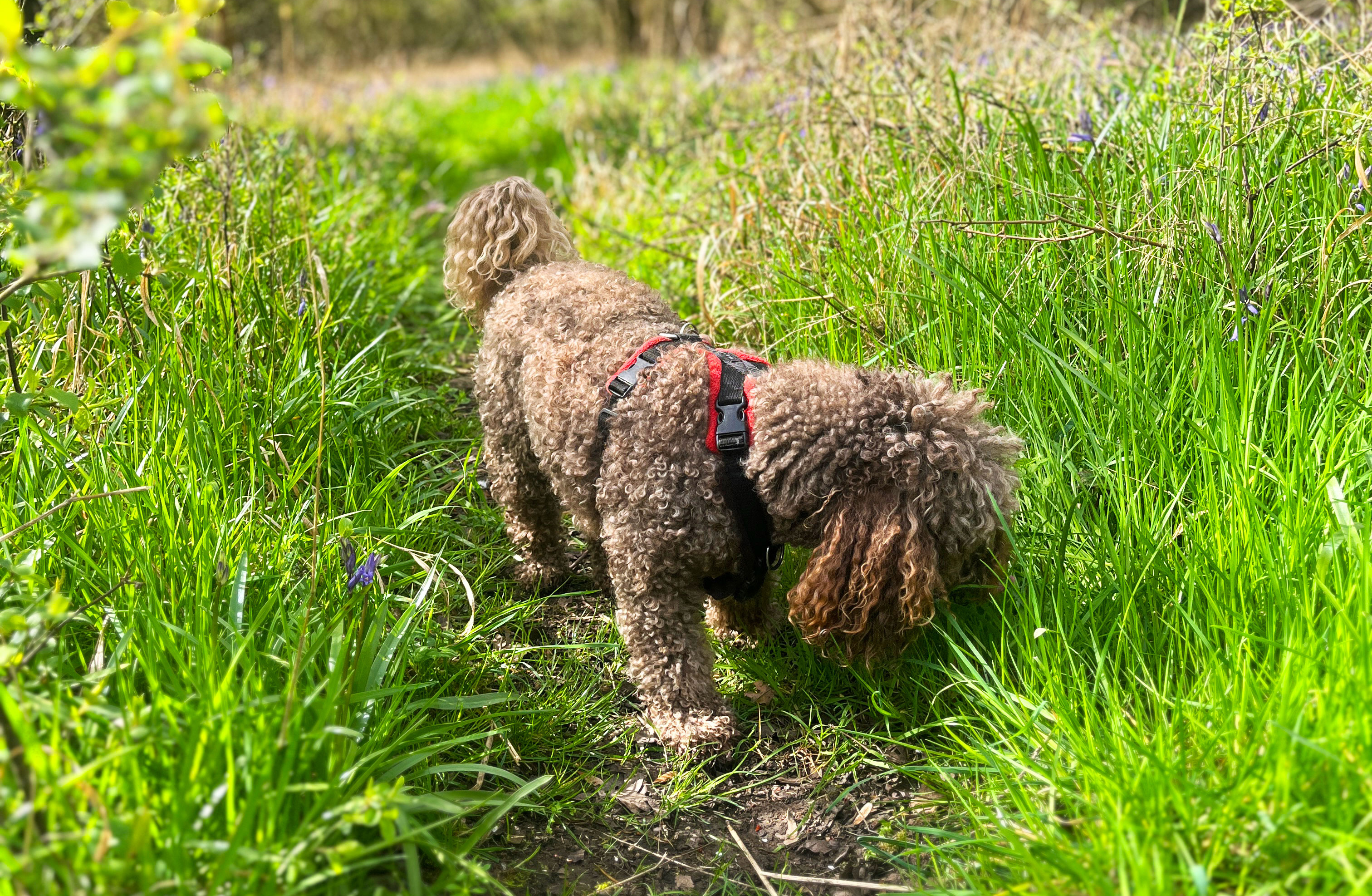
There are some things dogs just do better.
Greeting people with genuine enthusiasm. Napping without guilt. Finding joy in the same walk you did yesterday, and the day before, and the day before that.
Sydney, in particular, has been reminding us here at Keystone of the value of a good wander.
Through the flowers, into the long grass, nose down, ears up and fully committed to the moment. No inbox. No notifications. No “just one more thing before lunch”.
Lovely work, Syd.
Of course, most of us can’t spend our working day bounding through the undergrowth, however appealing that might sound. But there is something important in the idea of stepping away.
Not as a treat when everything is finished. Not as something you have to earn. Just as a way to give your brain a bit of room.
Because we’re all guilty of sitting at our desks for too long. After a while, everything can start to feel a bit cramped: our thinking, our patience and even our perspective.
So, if an idea won’t quite land, or you’re still staring at the same email after reading it 14 times, sometimes the best thing you can do is leave it alone for a bit.
Go for a walk around the block. Spend ten minutes in the garden. Step outside. Move. Look at something that is not a screen.
And if you are eating sandwiches at your desk again, getting crumbs in the keyboard, that is probably your sign.
A change of scenery can do more than we give it credit for. It gives your mind something different to work with. It can help loosen a conversation, shift a mood or make space for the thought that would not come when you were trying to force it.
The same applies at work. Not every useful conversation has to happen in a meeting room. Not every good idea arrives because someone has booked 30 minutes in the diary and added an agenda.
Better thinking often comes when there is a bit more space around it. Better conversations happen when people feel human, not hurried. And better work comes from people who have had a chance to breathe.
There are plenty of things we can learn from dogs. They can help with your marketing too, but that is a conversation we had last time.
For now, if your brain feels stuck, take a leaf out of Sydney’s book.
You don’t have to disappear into a field of flowers, although frankly we wouldn’t blame you.
Just step away for a moment.
Your inbox will still be there when you get back.
Annoyingly.
Prepare for an uncomfortable reality: Humans are self-obsessed.
If you feel offended, don’t be! It’s not your fault. It’s hard-wired. Not a choice or a personality flaw. Ultimately, it’s what kept your ancestors alive.
While the risk of being chased by a sabre-toothed tiger is (thankfully) fairly slim these days, old habits die hard. Our subconscious is working round the clock, scanning for threats and opportunities that help us live to see another sunrise.
This innate programming, to notice the things that appeal to our self-interest, is not a challenge. It is a really powerful marketing tool.
When something looks and feels like it was made for us, our attention locks in. It is why the first question we always ask, when creating any form of marketing or communication, is: who is your audience?
Capturing attention – and let’s not downplay how difficult this is – is the first challenge. The next is what you do with it. And how long do we have to do this? In many cases, probably only a matter of seconds.
Time for another uncomfortable reality: you might think you’re in charge of making rational, considered decisions. You’re not. Your brain is making over 35,000 subconscious decisions for you, every single day. Imagine how exhausting life would be without this subconscious processing, especially if you already find it hard to decide what to have for dinner each night!
A useful shortcut from attention to engagement is emotion, because emotion is part of your fast brain and your ingrained need for self-preservation.
Getting “spidery” fear signals? Be wary, stay alert.
Did something make you smile? You’re safe, you can relax.
Feeling seen? Now you’re listening.
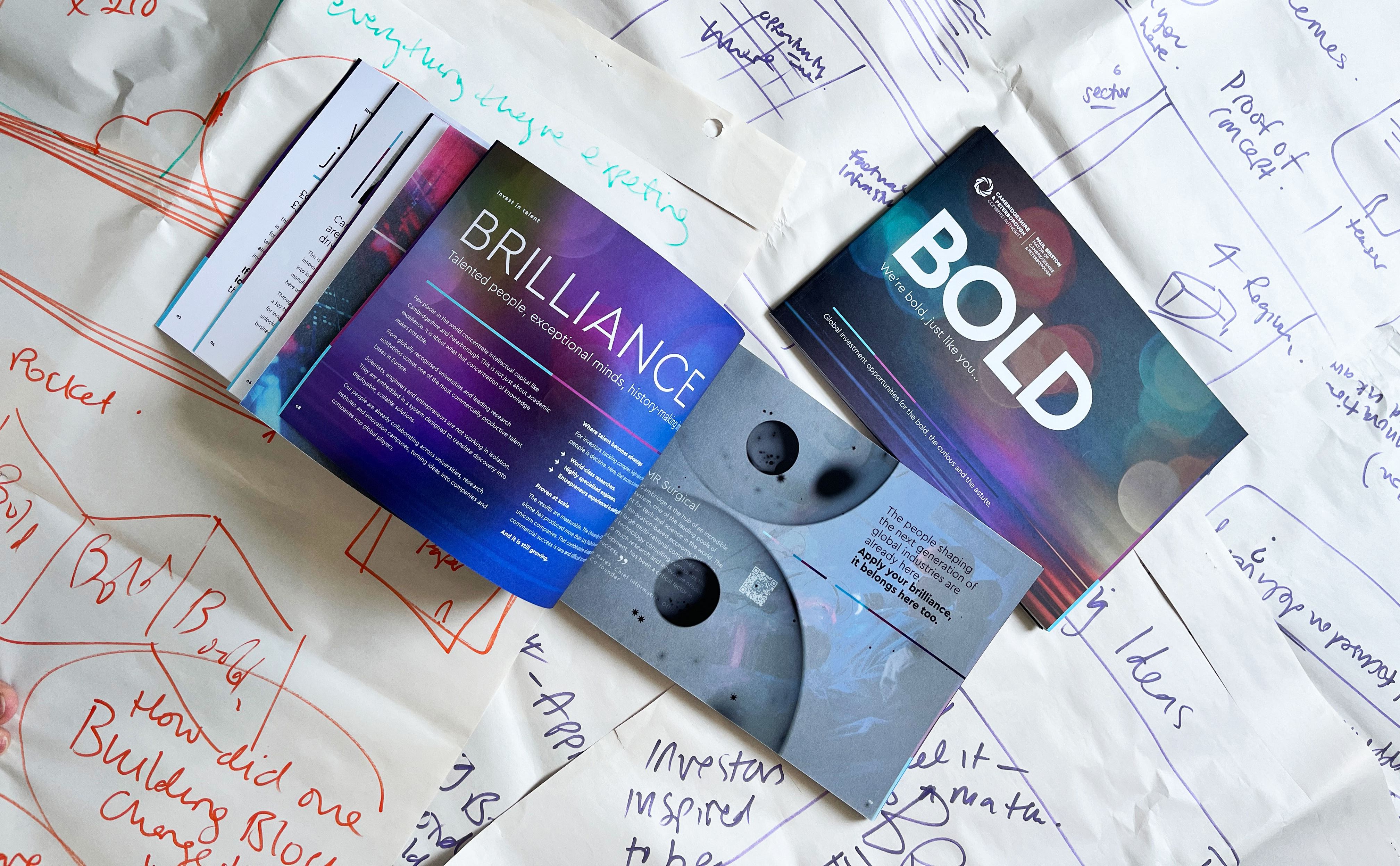
A brilliant example is our recent project with Cambridgeshire and Peterborough Combined Authority. We had a clear brief: create a prospectus for UKREiiF, the UK’s Real Estate Investment and Infrastructure Forum, where investors, developers, local authorities and senior decision-makers come together to explore opportunities, build partnerships and accelerate investment.
Understanding the audience was a big focus of the discovery workshop. We needed to get beyond “investors” as a broad label and think about what this audience is really looking for.
Investors and developers don’t just want information. They look for signals. Momentum. Confidence. Credibility. Opportunity. The sense that something is happening and, importantly, that they have spotted it at the right time.
They are bold. Curious. Astute.
Just like the region.
We had a match!
“Just like you” became the strategic and creative thread for the prospectus.
The opening proposition, “Global investment opportunities for the bold, the curious and the astute”, immediately reframed the document around the audience, not just the place. It then mirrored those qualities back to the reader: “We’re bold, just like you”, “We’re curious, just like you” and “We’re astute, just like you.”
This was not flattery for the sake of flattery. It was relevance.
“Just like you” worked because it positioned Cambridgeshire and Peterborough as a place with the same qualities the audience values in themselves: ambition, intelligence, pace, judgement and appetite for growth.
We weren’t just asking investors to look at the opportunity. We were inviting them to recognise themselves in it.
The bold approach did not end with the copy.
We wanted the design treatment to embody the same confidence. The result: striking typography, image-led storytelling, bold section openers, interleaved with tactile, transparent pages, and a more editorial rhythm. The prospectus demonstrated greater pace and more presence than any of the other regional prospectuses we’d looked at during our competitor analysis.
Ultimately, it made investors feel that Cambridgeshire and Peterborough was the kind of place they would naturally be drawn to. A place of momentum, intelligence and ambition. A place for people just like them.
That is the power of audience-first communication.
When people see themselves in your message, they are more likely to give it their attention. When they see their ambitions reflected back with credibility and confidence, they are more likely to believe the opportunity is worth pursuing.
Appealing to the ego might sound uncomfortable. But done well, it offers the most direct route to recognition and engagement.

When most people think about “tone of voice”, they imagine glossy brand bibles and large marketing teams. But tone isn’t just for the giants. It’s the most human part of your brand and it matters just as much when your team is only ten people strong and juggling a hundred jobs!
That’s what makes defining your tone of voice such a powerful act. It’s not a vanity project, it’s about consistency, connection and culture. Done well, it can unlock clarity and confidence across your whole organisation, build trust and, crucially, save time! That’s what we saw firsthand when we partnered with Cambridgeshire ACRE.
“At Cambridgeshire ACRE, we’re a small team with big ambitions. With 18 staff all communicating in slightly different ways, I knew we needed a consistent tone of voice. Something that could reflect our newly developed organisational values and help us speak with one voice while still sounding human and approachable.” – Cambridgeshire ACRE
Cambridgeshire ACRE is a respected charity that’s been serving rural communities for over a century. They’ve grown steadily, and with that came a familiar challenge: more people writing on behalf of the organisation, across social media, in reports, as part of funding bids and in blog posts, but without a shared language or reference point.
Our work together started with a simple need: to help everyone write in the same voice, regardless of their role. But it quickly became something bigger. We surfaced the personality that already existed – approachable, passionate, grounded – and shaped it into something practical, human and, above all, useable.
“What came back was a set of values and a tone of voice that sound exactly like us: clear, warm and rooted in what we believe in.” – Cambridgeshire ACRE
We created a framework that:
“Chantal and Hayley completely got it. From the first conversation, they understood what I was trying to achieve and why.” – Cambridgeshire ACRE
When we began working with Cambs ACRE, the brief did not include AI. But as we got under the skin of their challenge, with multiple people writing from different perspectives and all needing to sound consistent, we saw a gap. Our recommendation was to create a reusable AI prompt that would act as a writing support tool, stitching their new tone of voice into everyday content creation.
Part of our work included tailoring that prompt to Cambridgeshire ACRE’s voice. It helps staff generate first drafts in ChatGPT that hit the right level of formality, warmth and credibility right from the off. No more blank pages and no more guesswork.
“After sharing the final documents with the team, it became obvious that we needed a simpler way to embed them into everyday writing. Chantal responded brilliantly, creating an AI prompt that we now use as a tool to sense-check and strengthen everything from blogs to news stories.” – Cambridgeshire ACRE
The prompt was built on the tone of voice guidance we had co-created with Cambs ACRE, so that when someone uses it to draft a blog or social post, they can focus on telling the story of their project, the part they know best, with peace of mind that the wording will also hit the right tonal notes. In practice, it means even non-communications staff can produce copy that feels on-brand. It is already saving time, reducing stress and, crucially, it protects the brand personality at every touchpoint.
This was never about ticking a box. It was about thinking bigger, offering a solution they did not know existed until we raised it as their trusted partner. By proactively identifying the need, we gave the team a tool that makes their guidelines instantly usable, every single day.
“The AI prompt has been a real game-changer for us. It’s taken the pressure off staff who don’t write often, and given us confidence that our voice will come through every time.” – Cambridgeshire ACRE
A unified voice across all written outputs means communications are now clearer, warmer and more efficient to produce. Everyone, from volunteers to trustees, knows how Cambridgeshire ACRE should sound. And just as importantly, how it shouldn’t. It matters because every interaction is an opportunity to inspire confidence, build trust and foster genuine connections.
“The difference has been immediate. Staff feel more confident in their writing, knowing they have a tool that helps them communicate clearly and consistently. One colleague, who had never written for an external audience before, used the prompt to draft a blog, submitted it and was genuinely moved by the positive response.” – Cambridgeshire ACRE
Without a clear, shared tone of voice, organisations face a number of emerging risks:
None of these are show-stoppers in isolation. But together, they chip away at confidence, internally and externally. A clear tone doesn’t just solve this; it prevents it altogether.
Tone of voice isn’t just about sounding good. It’s about sounding like you. As organisations grow, adding team members, broadening audiences, communicating more often, it becomes harder to sound consistent. And yet that’s when consistency matters most.
For organisations like Cambridgeshire ACRE, who balance professionalism with community connection, tone becomes the thread that ties everything together. It’s not a luxury. It’s infrastructure.
If you’ve never thought about your tone before, now might be the time if:
You don’t need a 50-page tone of voice document. But you do need clarity, a shared understanding and a way to put it into action.
Keystone can guide you through it. We work closely with teams to surface their authentic voice, define what good looks like and embed it across everything you write. The result? Communications that feel more human, more consistent, and more you.
“I wouldn’t hesitate to recommend working with Chantal. She was responsive, positive and supportive throughout and the end result has made a real difference to how we communicate with the world.” – Cambridgeshire ACRE

A three-year campaign for a vibrant and inclusive arts programme.

Brand identity visuals and messaging built with co-design principles at the core.

Call us on 01480 278750
hello@keystone-marketing.co.uk
Peppercorn House
8 Huntingdon Street
St Neots
Cambridgeshire
PE19 1BH

